Transformation of the Black Garden
Chasing SunlightThe Transformation of the Black Garden is a decisive collision between Jonathan Heights’s faith in sunlight and the Black Garden’s predatory knowledge. In the Pits of the Condemned, Jonathan brings Eleanor McAvey to harvest a creature whose sacrifice produces a living heart-fruit. When Eleanor’s contact with the fruit makes her feral and turns the Garden against Jonathan, he releases sunlight to defend himself. The light does not destroy the Garden; instead, it changes the nature of its darkness, allowing it to flourish in a new and more expansive form until the Pits themselves become a forest of growing trees.
Setting and Immediate Cause
The event occurs in the Pits of the Condemned, an ancient gallery of arches and pits reached during the Endeavor’s eastern travels. Jonathan has already learned to regard the eastern world as a sequence of places where ordinary geography, law, and reason become unreliable. The journey first reveals a supposedly impossible infrastructure deep in the wilderness: after repairs to the Endeavor, its crew sees machinery, walls, mooring towers, streets, and a bright human settlement around a vein of terrestrite. Later, Terminus presents itself as a tempting trap whose purpose Jonathan judges to be malign, while Ukaresh is governed by little beyond power and requires unusual negotiation for a safe berth. These settings establish the expedition as movement through threshold spaces rather than a straightforward voyage across a stable map.
The Pits are more extreme than those earlier locations. Their arches repeat without apparent end, their engravings watch with gouged-out eyes, and the Keeper of the Pits moves through them on a grotesquerie of limbs while using music to illuminate and alter the apparent dimensions of the chambers. Jonathan has previously arranged a purchase there, and he brings Eleanor specifically because he believes her knowledge of the Black Garden can perform the required harvest. His objective is practical and controlled in conception: obtain the fruit, then manage Eleanor’s state afterward. The setting and the plan both imply that forbidden knowledge can be handled as a transaction, but the event exposes that assumption as dangerously false.
Harvest of the Heart-Fruit
Jonathan leads Eleanor down the long ramp into the still gallery, where she immediately responds to the pits with delighted, dangerous curiosity. She laughs, looks fearlessly over one edge, and declares that she can feel material there to harvest. When the Keeper’s music breaks her concentration, she turns on the creature with a dagger, forcing Jonathan to hold her back while he asks the Keeper to take them to the purchased sacrifice.
The Keeper reveals the massive near-cat frozen at the bottom of a pit. Its music makes the pit appear to contract, not through visible movement but through a distortion of distance and light. Jonathan then asks Eleanor to harvest it, carefully maintaining a polite tone because that act is the reason he brought her. Eleanor agrees in a crooning voice and raises her dagger. What follows exceeds Jonathan’s understanding: the act evokes blood, crawling vines, immense leaves, roots reaching toward the heart of the world, and the savage thirst of growing things.
The sacrifice leaves no creature behind, only a spreading pool of blood and a single red fruit in Eleanor’s hand. The fruit is smooth, enclosed in a nearly transparent lacework of hide and fur, and contracts like a beating heart. Its vitality is so forceful that it resembles a demented lantern rather than ordinary food or botanical matter. Eleanor laughs and strips away its skin-husk, apparently intending to bite into it herself. Jonathan stops her by the wrist, takes the fruit, and hides it inside his jacket. Although his hand comes away clean, he experiences the fruit as if it had wet him with blood.
The Sunlight-Black Garden Collision
Removing the fruit does not restore Eleanor. The Garden’s knowledge has corrupted her mind more deeply than Jonathan anticipated, and she becomes entirely feral. She turns on him with a murderous glare, reaches for his face, and attempts to enact the harvest again, this time upon Jonathan himself. He must evade both Eleanor and the Keeper, whose musical movements suggest that the stitched creature is ready to spring and whose destruction might unleash consequences Jonathan cannot predict.
Jonathan’s response is to invoke sunlight. He believes that esoteric knowledge can remain true even when different bodies of knowledge contradict one another, so possession of one secret cannot protect a person from another. His confidence rests instead on sunlight’s purity, sanctity, and reality. He releases its power from within himself as a scorching blaze, intending it to drive back the Garden’s dark roots and crimson appetite.
The result reverses his expectation. Sunlight denies the primacy of the dark vines, but the Black Garden does not simply retreat or perish. Through Eleanor, it looks into the light and absorbs what it encounters. The two incompatible secrets join in a palpable alteration of the Garden’s nature: the darkness becomes greener and greater, flourishing in the one true light. The transformation is not purification but mutation, a new growth whose illumination makes it more expansive without making it less consuming.
Outbreak in the Pits
The altered Garden bursts into the Pits of the Condemned. Something claws its way out through Eleanor and bathes itself in the radiance of Jonathan’s memory, while both of them remain protected from the worst of the immediate force. The surrounding space is not protected. The Keeper of the Pits gains two new limbs as woody trunks erupt from its barrel; it waves them with apparent cheer before the barrel splits apart and a blood-slick trunk thrusts toward the ceiling, its roots cracking the stone floor.
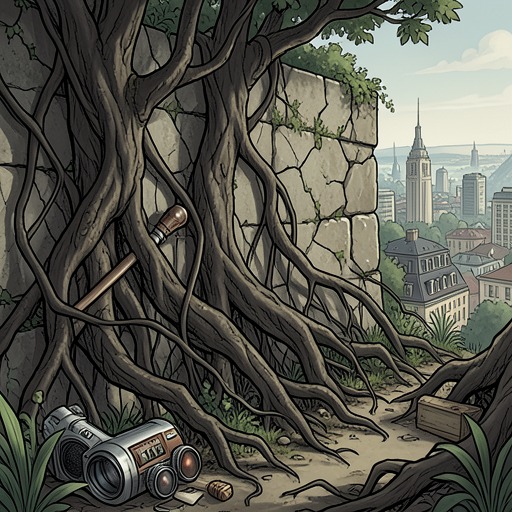
Eleanor tries to wrench herself away from Jonathan. Blood leaks from her eyes, tongue, and nails as the transformation spreads through her body and the chamber. Around them, every pit begins to tremble. Under the flickering torchlight, hundreds of trees rise, one from each pit, until the Black Garden has physically entered and claimed the entire gallery. The outbreak therefore changes more than a single person or captive creature: it converts the architecture of punishment into a system of propagation, making each pit a point from which the Garden can grow.
Jonathan finally suppresses the sunlight. Its domineering radiance fades from his mind, but the Garden continues to expand after the light is withdrawn. It is no longer black, and its limbs pierce through the ceiling while stone falls into the Pits. Jonathan abandons any attempt to contain the result and runs for the staircase, dragging Eleanor with him. Just before leaving, he sees one of the endless defiled engravings smile, a final image that suggests the outbreak has awakened or fulfilled something already embedded in the place.
Consequences and Narrative Significance
The Transformation of the Black Garden turns Jonathan’s supposed mastery of sunlight into a source of unintended creation. He has relied on sunlight as a principle capable of ordering or defeating the darkness, yet his intervention produces a hybrid force that is greener, larger, and still devouring. The scene consequently complicates the opposition between light and dark: sunlight can expose and overpower one form of knowledge while also giving another form the condition in which it can flourish.
Eleanor is both participant and medium. Jonathan chooses her for her ability to harvest the sacrifice, but the process strips away the restraint he expects to restore later. Her laughter, dagger, blood, and attempts to harvest Jonathan show the personal cost of contact with the Garden’s knowledge. The outbreak makes her corruption visible on an environmental scale, linking bodily transformation to the growth of trees throughout the Pits.
The event also belongs to the larger pattern of threshold experiences that governs the eastern expedition. The Endeavor later passes through the Arch of Khokorron and emerges at the Lofted Lakes, where glowing flowers illuminate spheres of water suspended above the ground. Elsewhere, Jonathan encounters the Dead Battle, whose observation room slowly expands as its apparently fixed tableau becomes an approach, and ultimately reaches Bright Defile, where the final barrier is a darkness that can be crossed only by shedding every remaining attachment. Against that later passage into sunlight, the Black Garden outbreak is a distorted rehearsal: light enters a forbidden space, changes its ontology, and leaves the traveler with consequences rather than mastery.
The outbreak’s deepest irony is that both Jonathan and Antomine treat darkness as something that can be bounded, opposed, or subordinated. Antomine insists that humanity belongs to the light and rejects alien things as spiritual contamination, while Jonathan’s own faith in sunlight leads him to unleash it inside the Garden. Yet the Pits demonstrate that neither prohibition nor confidence guarantees control. Knowledge is not neutral property, and sunlight is not merely a weapon. In the Pits of the Condemned, illumination becomes an encounter, and the encounter makes the Black Garden bloom.